
For years, 100kW has been a significant dividing line for commercial solar in Australia.
Under the Small-scale Renewable Energy Scheme (SRES), solar PV systems have historically needed to be no more than 100kW to qualify for Small-scale Technology Certificates (STCs). Systems above that threshold generally fell under the Large-scale Renewable Energy Target (LRET), with a substantially different accreditation and certificate process.
As a result, many businesses deliberately installed solar systems of around 99kW or 99.9kW, even where their electricity consumption, available roof space and daytime load could potentially justify a much larger system.
That is about to change.
SRES proposed to expand to systems below 1MW
On 5 August 2026, the Australian Government announced an expansion of solar PV eligibility under the Small-scale Renewable Energy Scheme.
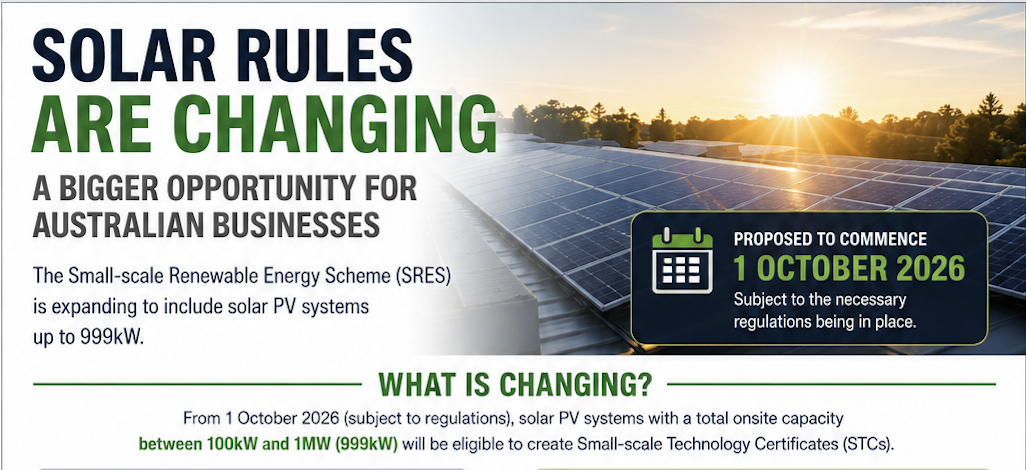
Under the proposed changes, solar PV systems with a total onsite capacity between 100kW and 1MW will become eligible to create Small-scale Technology Certificates (STCs).
The changes are intended to apply to eligible mid-scale solar installed from 1 October 2026, subject to the necessary regulations being in place. The Clean Energy Regulator has advised that further details regarding design, installation, compliance and eligibility requirements will be released before commencement.
This represents a significant change for commercial, industrial and agricultural electricity users.
Why did so many businesses stop at 99kW?
The previous SRES threshold created a strong incentive to keep commercial solar installations below 100kW.
Even where a business had sufficient roof space and electricity demand to support 200kW, 300kW, 500kW or more of solar, moving beyond the 100kW threshold meant entering the Large-scale Renewable Energy Target framework rather than receiving the simpler upfront STC incentive.
Consequently, the size of many commercial solar installations was influenced not simply by how much solar the business could economically use, but by the regulatory framework applying at the time.
For some businesses, that may have resulted in a system considerably smaller than their site’s actual solar opportunity.
If you installed 99kW, it may be time to revisit the numbers
If your business previously installed approximately 99kW of solar because of the SRES threshold, now is an excellent time to reassess your site.
The question should no longer simply be:
“How much solar can we install while remaining below 100kW?”
Instead, it should be:
“What size solar system provides the best commercial outcome for our business?”
For a business with significant daytime electricity consumption, that could potentially mean increasing an existing installation from around 99kW to several hundred kilowatts.
The right answer will be different for every site.
Bigger isn’t automatically better
While the expanded SRES potentially makes larger commercial solar installations more attractive, simply filling every available square metre of roof space with panels isn’t necessarily the best strategy.
A proper feasibility assessment should consider:
- the site’s interval electricity consumption and daytime load profile;
- the output of the existing solar system;
- available roof area and orientation;
- existing switchboard, electrical and inverter infrastructure;
- network connection and export limitations;
- expected self-consumption versus exports;
- current electricity tariffs and avoided electricity costs;
- the potential value of STCs;
- capital cost and expected payback period;
- future electricity consumption;
- electrification plans, including EV charging;
- battery storage opportunities; and
- whether upgrading the existing system or installing additional solar provides the better outcome.
This is particularly important because the greatest financial value from commercial solar will generally come from using the electricity onsite and avoiding electricity purchased from the grid, rather than simply maximising generation.
There may be a significant opportunity sitting on your roof
Consider a business that installed a 99kW system several years ago.
If that site operates during daylight hours and continues to import thousands of kilowatts from the grid even while its existing solar system is operating at full output, the original system may now represent only a fraction of the site’s economically viable solar capacity.
Under the proposed SRES changes, increasing that solar capacity could potentially become considerably easier to justify.
Importantly, businesses shouldn’t assume that an existing 99kW installation can simply have hundreds of additional panels connected to it and automatically receive STCs.
Eligibility for expansions, existing equipment, new equipment and previously claimed certificates needs to be properly assessed. STCs cannot simply be claimed again on panels that have already received them, and the Clean Energy Regulator has indicated that additional requirements for mid-scale systems will be released before the new arrangements commence.
Timing also matters
STCs provide an upfront financial incentive based partly on the renewable electricity a system is expected to generate over the remaining deeming period.
That deeming period reduces each year until the SRES finishes in 2030. For systems installed in 2026 the deeming period is five years, reducing to four years in 2027, three in 2028, two in 2029 and one in 2030.
That makes it worthwhile for businesses considering an expansion to start investigating their options rather than waiting until the final years of the scheme.
Negawatt can assess whether increasing your solar capacity makes sense
If your business previously installed a 99kW or 99.9kW solar system because of the former SRES threshold, the upcoming changes provide a good reason to revisit the decision.
Negawatt Energy Solutions can review your electricity consumption, existing solar generation and interval meter data to determine whether increasing your solar capacity is technically and financially worthwhile.
We can help assess:
How much additional solar could your business actually use?
What system size is likely to provide the best return?
How much grid electricity could additional solar displace?
What are the likely savings and payback period?
How could the expanded SRES and STC eligibility affect the project economics?
The fact that 99kW made sense under the previous rules doesn’t necessarily mean it is the right solar capacity for your business today.
Already have 99kW of solar? Let’s run the numbers again.
Contact Negawatt Energy Solutions to discuss the feasibility of expanding your existing commercial solar system and determine whether the new SRES arrangements could create an opportunity to significantly reduce your future electricity costs.